UCSD Morimoto Robotics Lab
Thermocautery Knife
A miniature resistively heated cutting tip that cauterizes tissue without passing current through the patient, characterized with thermal imaging.
The problem
Cutting and cauterizing tissue inside the colon usually means an electrosurgical knife, which sends RF current through the patient to a return pad. On our nitinol wristed instrument, that current has to be kept carefully away from a conductive metal wrist millimeters from the knife.
Thermocautery takes a different approach. The tip is a small resistive element that heats itself when DC current runs through it, and it cuts and seals by conducting that heat into tissue. No current ever enters the patient, so there’s no return pad and no risk of stray current through the wrist.
Design requirements
- Miniature heating element small enough to work alongside the wrist and grasper.
- Heat concentrated at the tip, with a fast drop-off along the shaft, so only the target tissue is affected.
- Fast heat-up for responsive on/off control during cutting.
- Thermal isolation so the shaft and nearby instrument stay cool.
- A low-voltage DC supply, so no electrosurgical generator is needed.
Design
The tip is a resistive heating loop at the end of a flexible shaft. Current runs out along one conductor, through the high-resistance tip, and back along the other. Because the tip has much higher resistance than the leads, nearly all the power, and so all the heat, is dissipated right where the cut happens.
Fabrication
I fabricated the knife in-house. At this scale, small changes in tip geometry and the joints to the leads determine where the heat ends up, so the build focused on a consistent element length and low-resistance connections that don’t heat up themselves.
Testing
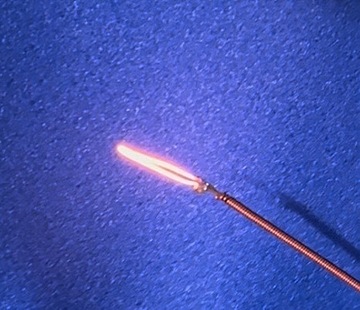
- Bench activation: under power, the element glows at the tip while the shaft stays dark, a quick visual check that the heat stays where it should.
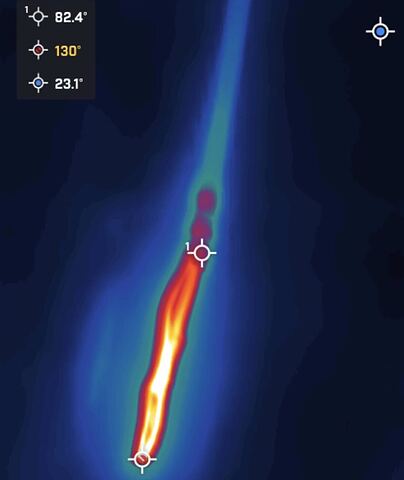
- Thermal imaging during activation confirmed the heat is concentrated at the tip, with a peak reading around 130° and a steep drop-off along the shaft.
What I took away
Building the same tool two ways, with electrosurgery and with thermocautery, made the trade-offs concrete. Electrosurgery cuts faster but requires careful electrical isolation. Thermocautery is electrically safer and simpler to power, but everything comes down to managing where the heat goes.
Gallery
Related projects
UCSD Delson Engineering Lab · 2023 – 2024
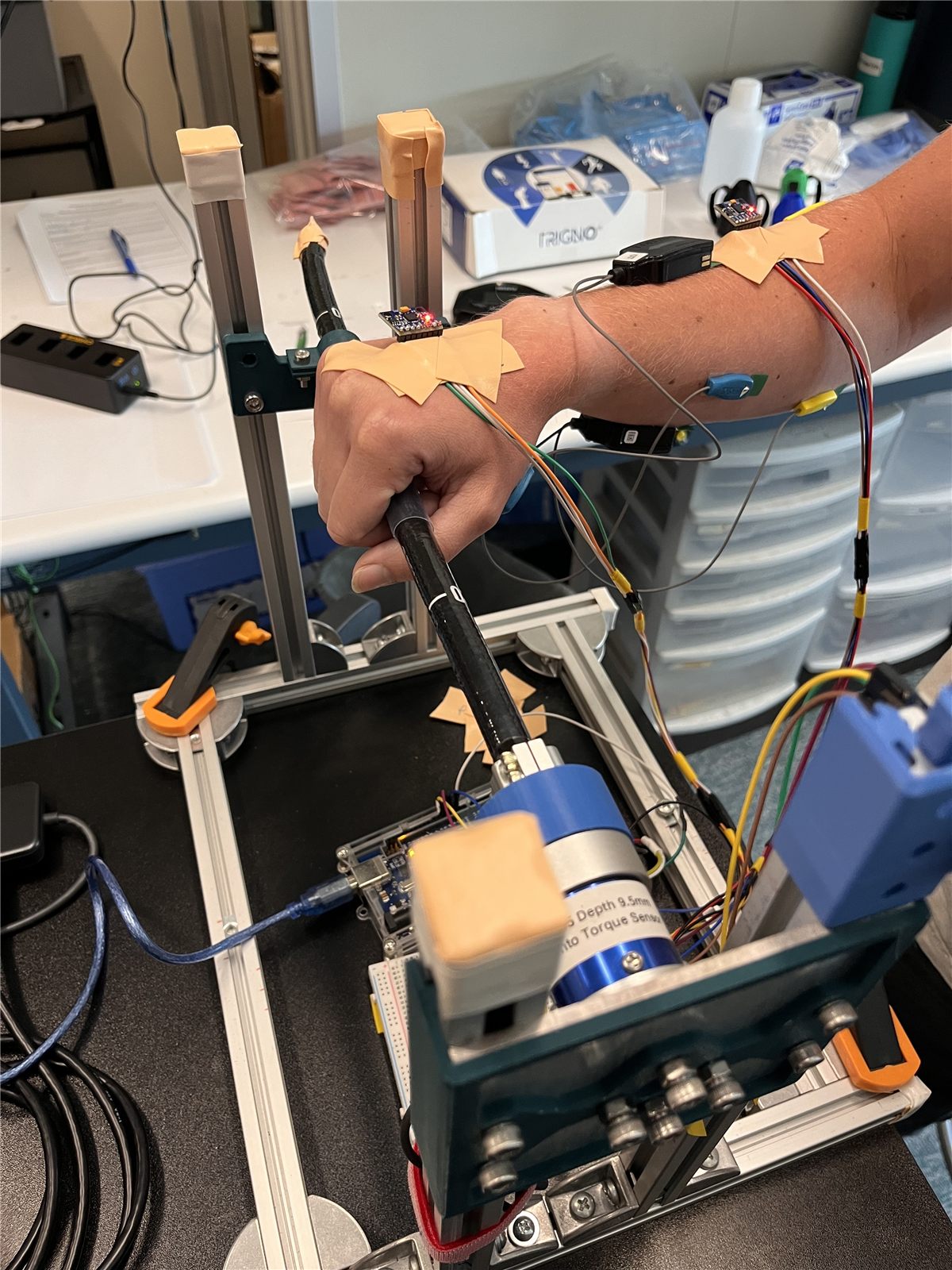
Colonoscope Manipulation Tools & Test Rig
External tools that make colonoscopes easier to handle, plus a portable rig for collecting torque and EMG data on a colonoscopy simulator.
UCSD Morimoto Robotics Lab · 2025 – Present
Sub-Millimeter Electrosurgical Knife
A sub-millimeter electrosurgical knife designed and fabricated for endoscopic submucosal dissection.
UCSD MAE 3 · Intro to Engineering Design · 2023
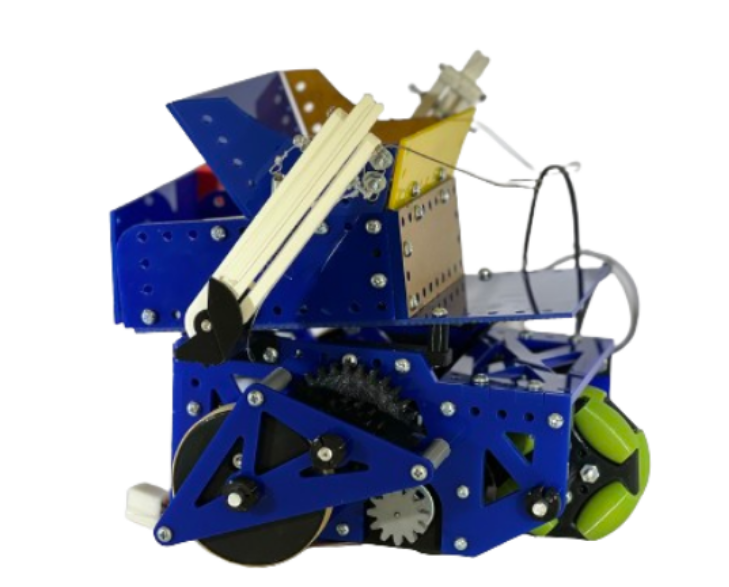
MAE 3 Competition Robot
A gear-driven collection robot with a hopper and pivoting arm, taken from Fusion 360 CAD to a laser-cut, bolted-together build for UCSD's MAE 3 design competition.