Geisel Library
IoT Patron-Item Tracker
An Arduino IoT tracking system that reports item status to library staff through Slack, plus automated syncing between Google Workspace and Ex Libris.
The problem
UCSD’s Geisel Library handles a steady flow of patron items: holds, returns, and materials moving between service points. Tracking where each item was and when its status changed was mostly manual. Staff checked shelves, updated spreadsheets by hand, and messaged each other to coordinate. Things got missed, and time went to bookkeeping instead of helping patrons.
The system
I built two connected pieces of automation:
 Item station (Arduino + sensors) ──Wi-Fi──► Slack API ──► team channel alerts
                                                   │
 Google Workspace (Sheets) ◄──── sync script ────► Ex Libris (library system)
Arduino IoT tracker + Slack library
- A Wi-Fi-connected Arduino detects item status changes at the station automatically.
- I wrote a reusable Arduino IoT library that formats status and user data and posts it to the team through the Slack API, so staff get a real-time notification instead of having to check.
- Packaging it as a library meant other stations or workflows could reuse it with just a few lines of code.
Automated database handling
The library’s records live in Ex Libris, while staff work day to day in Google Workspace. I programmed an automated system that moves data between the two, so updates in one show up in the other without manual re-entry or copy-paste errors.
Results
- Staff are notified automatically when item status changes.
- Far less manual data entry between Google Workspace and Ex Libris.
- Reusable code the team can extend to new workflows.
What I took away
The most useful engineering isn’t always the most complex. A small microcontroller and a few API calls removed a recurring headache for a whole team. Writing it as a reusable library rather than a one-off script is what made it last.
Related projects
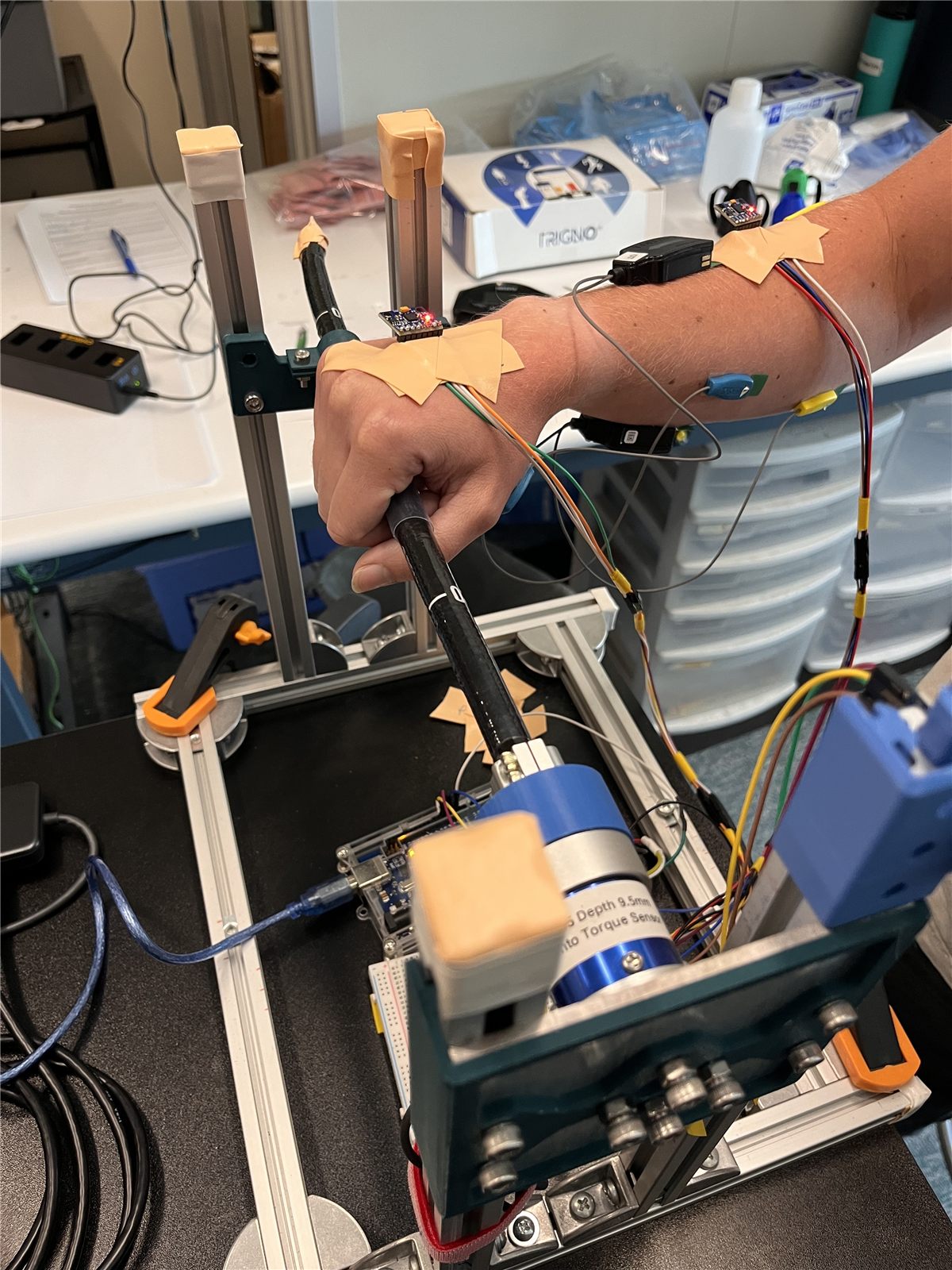
UCSD Delson Engineering Lab · 2023 – 2024
Colonoscope Manipulation Tools & Test Rig
External tools that make colonoscopes easier to handle, plus a portable rig for collecting torque and EMG data on a colonoscopy simulator.
UCSD Morimoto Robotics Lab · 2025 – Present
Surgical Robot Control & Data Pipeline
A ROS 2 layer that synchronizes a 40-dimension state space, with micro-ROS actuation and a VM-based TCP–ROS bridge for load cells, 6-axis force sensors, and EM tracking.